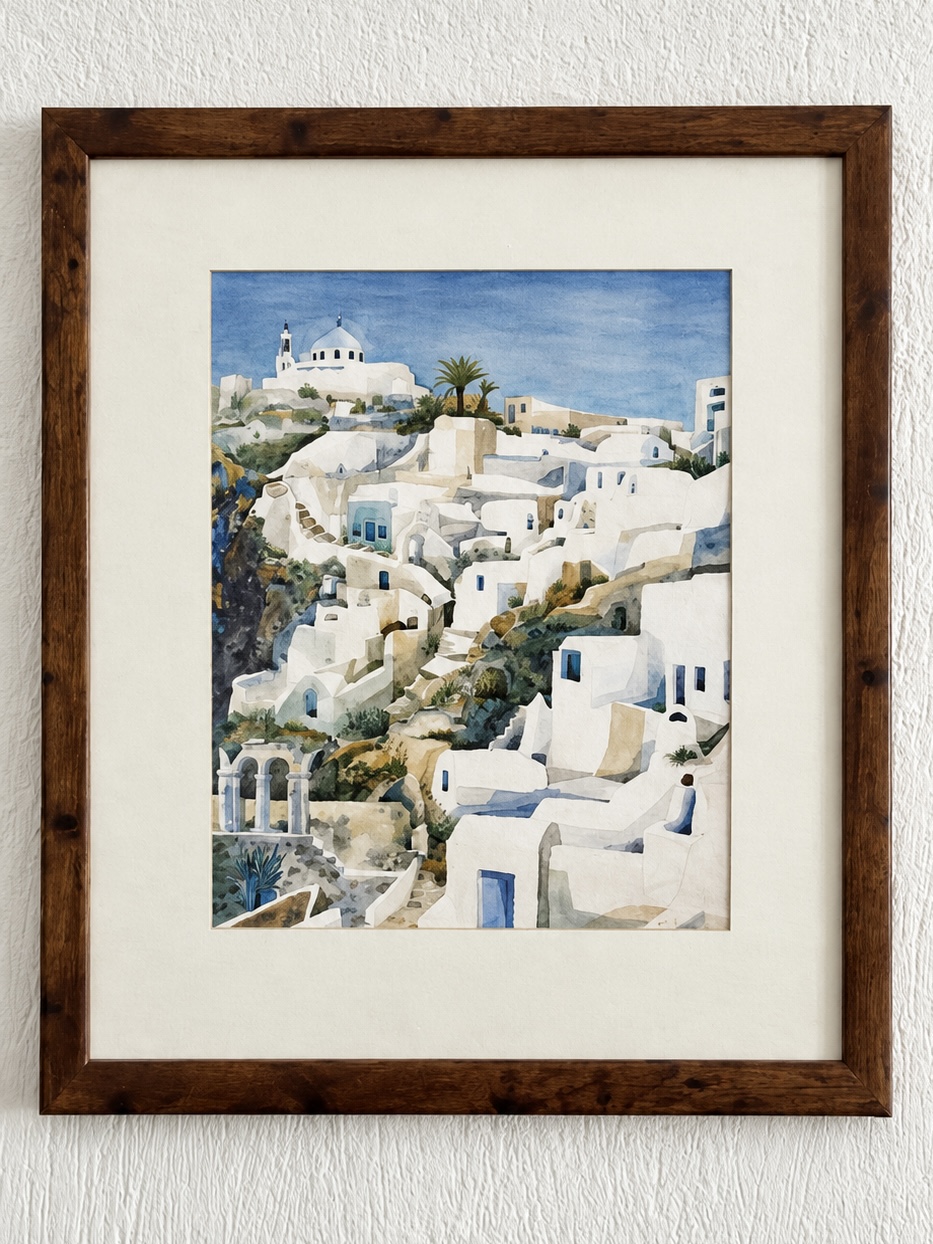

If you stay in House 2, you may notice that the pictures on its walls share the same hand.
They are not there because they matched the furniture, or because I was looking for something to fill an empty wall.
They are there because of Heidi.
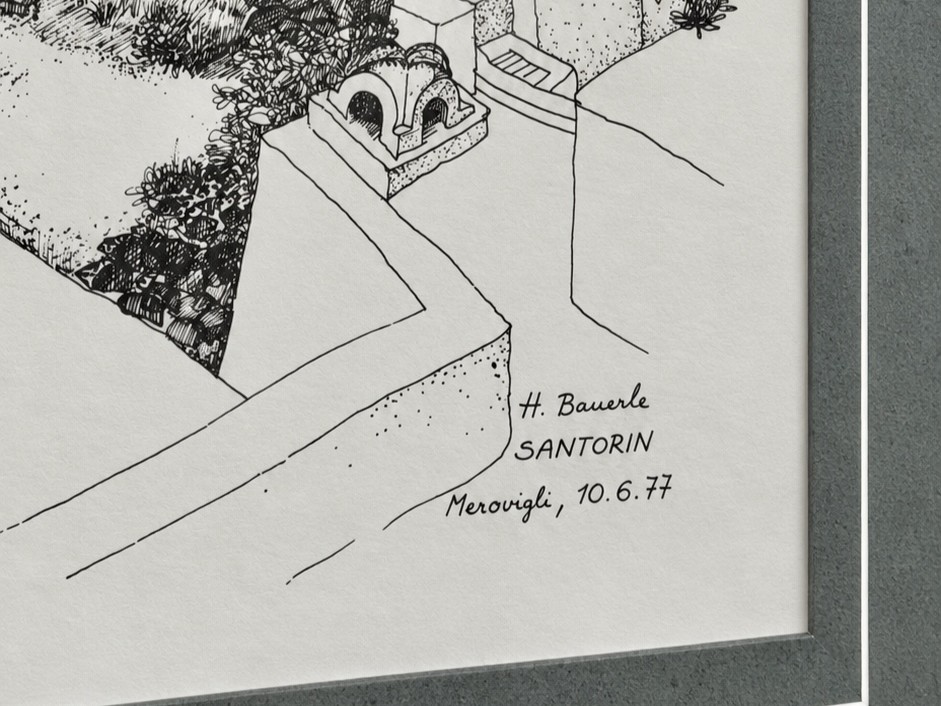
Heidi Bauerle came from Stuttgart, Germany. She first arrived in Santorini as a young visitor and fell so deeply in love with the island that she eventually bought an old house in Imerovigli from an elderly local man.
She restored it with remarkable sensitivity.
Heidi was an architect and illustrator, a highly educated woman with an exceptionally refined eye. She understood something that was not always taken for granted at the time: that an old island house did not need to be transformed in order to become beautiful.
Its beauty was already there.
She preserved its character and made it her home.
But Heidi did not simply have a house in Imerovigli. She became part of the village.
Among the people she grew close to was Georgia, the elderly woman who lived in what is now our House 2.
On paper, it would be difficult to imagine two women with more different lives.
Heidi was German, educated, cosmopolitan — an architect and an artist. Georgia was a woman of the island, with no formal education, who had spent almost her entire life within the small world of her village.
And yet they became friends.
I remember seeing them together.
They would sit and talk in Georgia’s house. I did not always hear what was being said — I didn’t need to. What stayed with me was simply the sight of these two women enjoying each other’s company, despite everything that, from the outside, might have seemed to separate them.
Two different languages, two different educations, two completely different experiences of the world.
None of it seemed particularly important when they sat together.
I have always loved that part of their story.
Because their friendship was not an idea about two worlds meeting. I actually watched those two worlds meet — naturally, quietly, without anyone thinking there was anything remarkable about it.
Heidi’s relationship with Imerovigli extended far beyond this friendship.
She genuinely loved the village, and over the years she became one of its quiet ambassadors. The older people here still remember her with affection and respect.
Around 1980, she also gave something to the community that remains here to this day.
She created a mural for the village cultural hall, asking nothing in return. More than four decades later, her work is still preserved in the space that houses the Cultural Association of Imerovigli.
Her drawings were another part of what she left behind. Heidi was particularly gifted with pen and ink, creating delicate, precise images with the same eye that had allowed her to understand the architecture and character of the island.
Many years later, Georgia’s house came into our hands.
When the time came for me to decide what should hang on its walls, I could have chosen beautiful pictures of Santorini. I could have bought works that suited the colours of the house.
But to me, there was only one choice that felt right.
Heidi’s pictures.
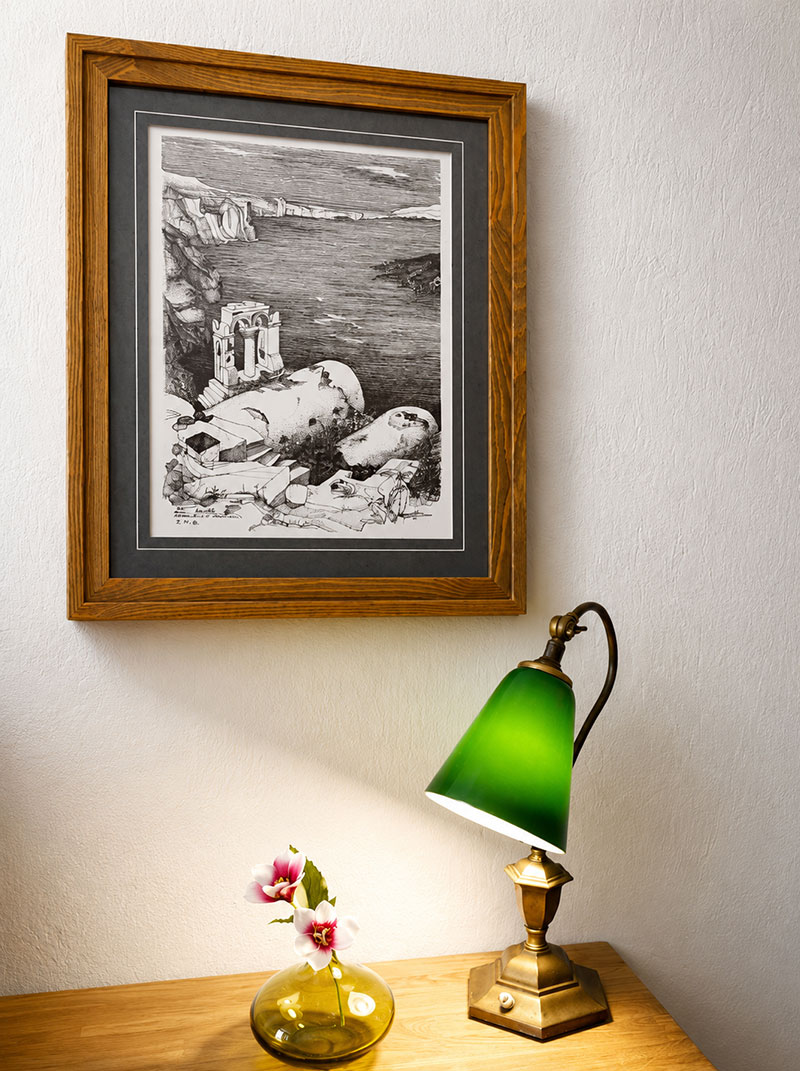
Because they have something that decoration can never have.
Memory.
They were made by a woman who knew this village, who loved it and became part of its life. More importantly for this particular house, they were made by a woman who had actually spent time within these walls, sitting and talking with Georgia, the woman who once called this place home.
So I brought Heidi’s pictures into the house.
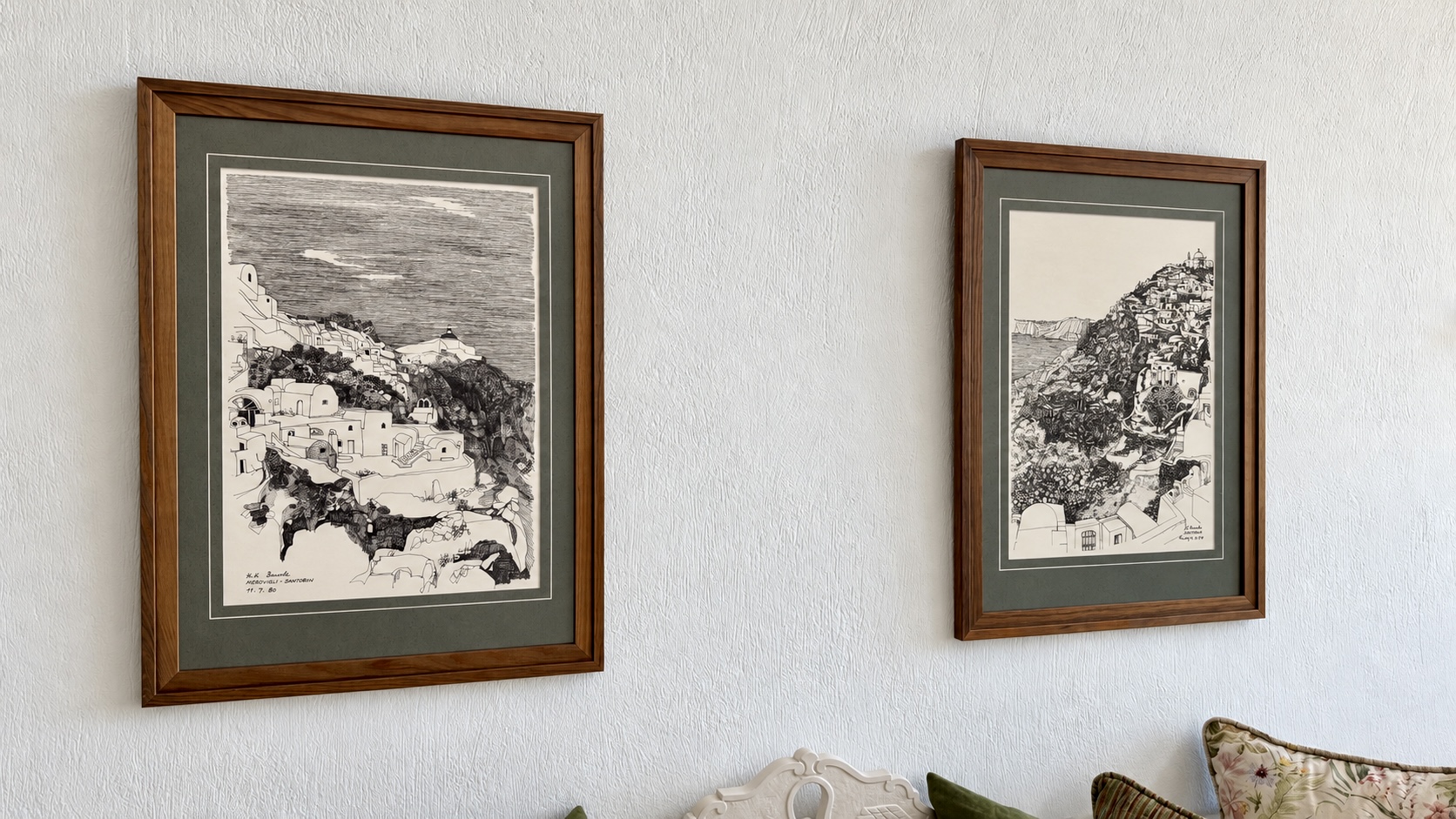
Today, guests live with them. They see them when they wake up, as they walk through the rooms, perhaps while having their morning coffee. Most will not know, unless I tell them, that the artist whose work they are looking at once sat in this very house as Georgia’s friend.
And this is why I wanted to tell their story.
I don’t think of Heidi’s pictures as decoration. To me, they belong here.
Old houses accumulate stories.
Some are written down. Some survive in photographs. Others remain because someone remembers them and decides not to let them disappear.
And sometimes, a story is still hanging quietly on the wall.